Accelerate business workflows with intelligent AI systems that can reason, make decisions, and execute actions autonomously—supported by our Agentic AI expertise.
Agentic AI represents the next evolution of enterprise automation. These intelligent systems go beyond analyzing information—they understand objectives, reason within context, make informed decisions, and take autonomous action.
We help organizations harness this intelligence through Agentic AI consulting services, leveraging advanced agent frameworks designed to address real-world business requirements and deliver measurable outcomes.
Agentic AI brings together capabilities such as planning, memory, tool utilization, multi-agent orchestration, and human oversight to enable adaptive, goal-driven execution across complex enterprise workflows.
How Agentic AI operates in modern businesses.
Analyzes complex enterprise objectives and autonomously maps execution paths.
Continuously accesses and synchronizes context from enterprise systems and knowledge bases.
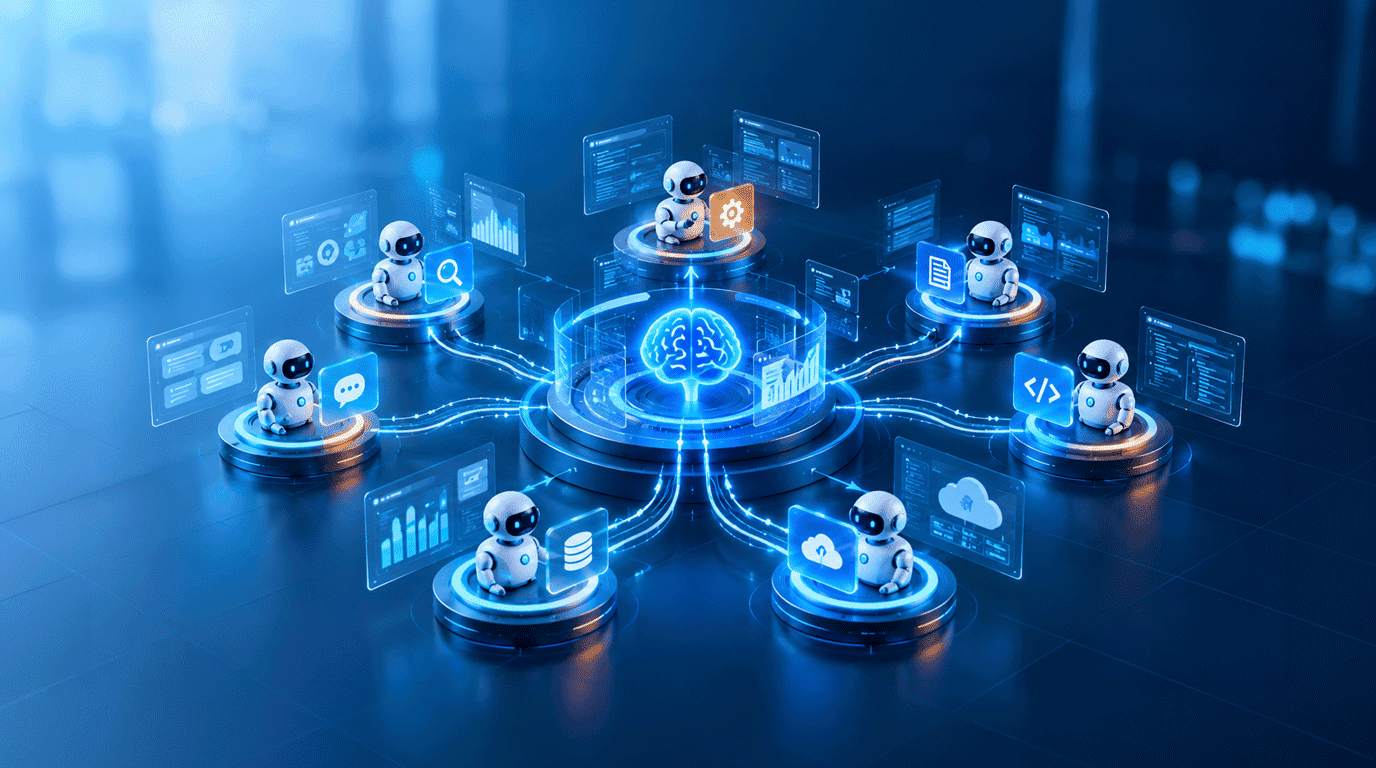
Orchestrates collaborative workflows across specialized domain agents.
Incorporates real-time evaluation and human feedback for continuous improvement.
Breaks large objectives into micro-steps for structured, reliable autonomous delivery.
Pulls data from internal systems, apps, and docs on-demand to maintain fresh operational context.
Assigns tasks between specialized agents with clear boundaries, permissions, and tool access.
Evaluates, corrects, and improves actions in-flight before critical execution steps.
Faster workflow execution with reduced cycle latency across end-to-end operations.
Accurate, context-aware decisions backed by real-time enterprise grounded data.
Handles complex, cross-functional workflows seamlessly without manual handoffs.
Reduces errors and improves reliability with integrated human-in-the-loop checkpoints.
Empowering enterprises with end-to-end autonomous agent capabilities—from strategic blueprints to continuous orchestration and compliance.
Our experts evaluate your organization’s AI readiness, identify high-value automation opportunities, and design intelligent agent-driven workflows. Our specialists define multi-agent architectures, integration frameworks, and governance models to enable scalable, secure, compliant, and high-performing adoption of Agentic AI.
Our AI specialists develop autonomous, task-oriented agents capable of reasoning, planning, and executing complex operations. By combining LLMs, RAG architectures, knowledge graphs, and tool-enabled workflows, we build customized Agentic AI solutions aligned with domain-specific requirements and designed for secure, scalable, enterprise-grade performance.
Our team designs and orchestrates collaborative multi-agent systems in which specialized agents handle reasoning, planning, execution, evaluation, and monitoring. We enable intelligent task delegation, coordinated decision-making, and continuous optimization across complex business processes to improve efficiency, agility, and operational performance.
Our specialists design distributed agent networks with shared memory, hierarchical control mechanisms, and secure event-driven communication. Our architecture enables scalable tool execution, modular agent deployment, and resilient orchestration, supporting secure and autonomous operations across complex enterprise ecosystems.
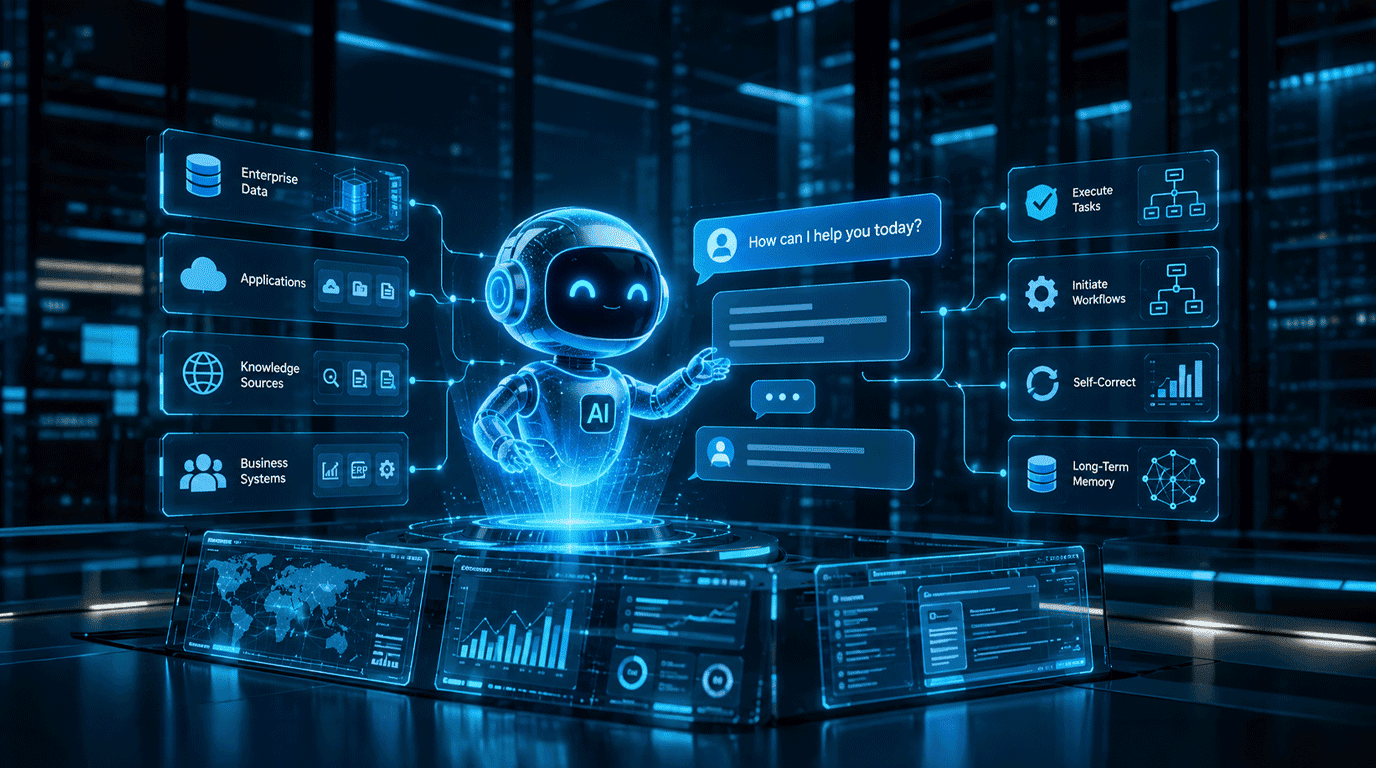
Our experts develop intelligent, context-aware conversational agents that seamlessly connect with enterprise data and systems. These agents can execute tasks, self-correct, initiate workflows, and maintain long-term memory while delivering natural interactions and reliable, data-driven decision support.
We automate complex business operations through coordinated chains of specialized AI agents responsible for validation, enrichment, compliance, and execution. Our specialists design intelligent workflows that can independently verify inputs, enrich information, apply business rules, and execute tasks—reducing manual intervention while improving process reliability, consistency, and efficiency.
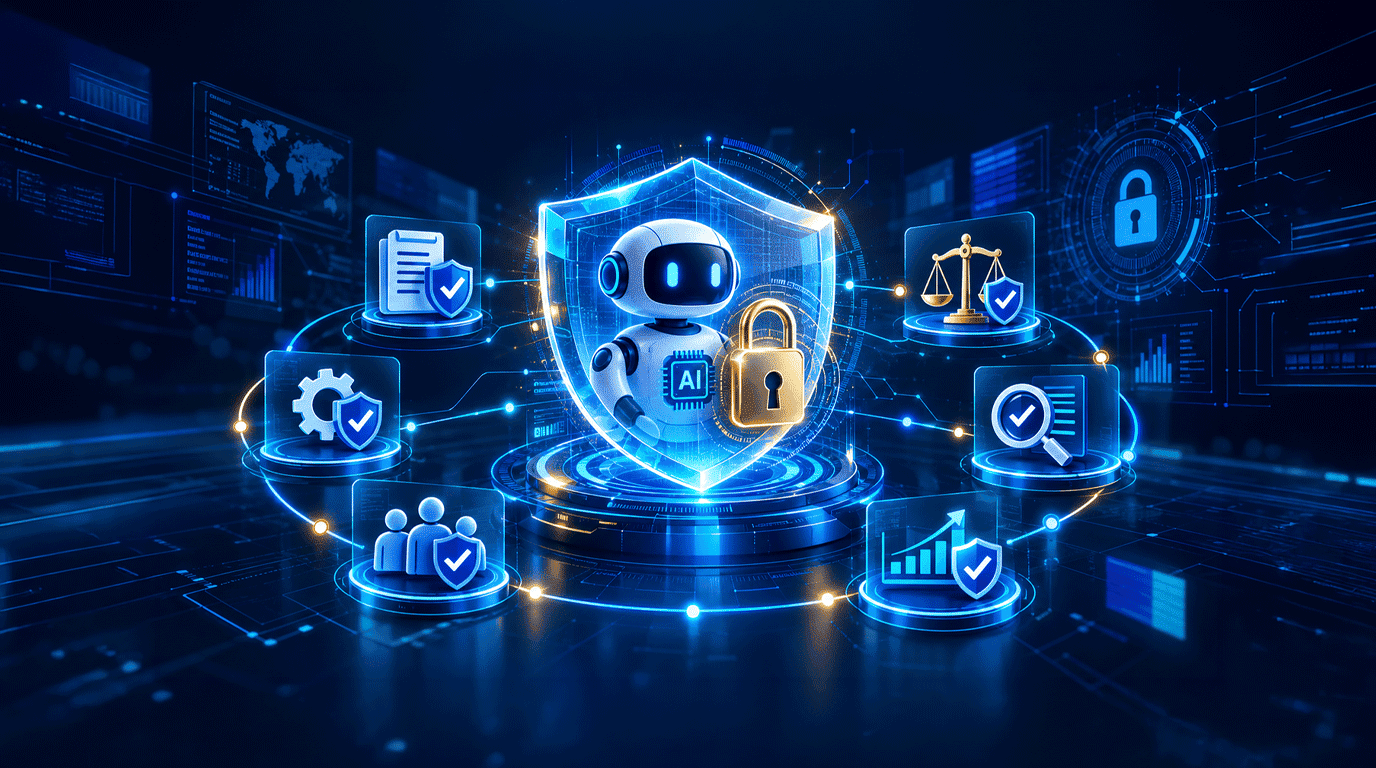
Our experts implement robust safety and governance mechanisms, including policy controls, action validation, human oversight, and risk assessment. We ensure AI agents operate securely within defined organizational boundaries, follow established standards, and support continuous compliance with applicable industry regulations in real time.
Our AI experts integrate Agentic AI systems with CRMs, ERPs, data lakes, APIs, IoT devices, and other enterprise platforms. We enable secure connectivity, seamless interoperability, event-driven orchestration, and low-latency data exchange to create a unified, scalable, and enterprise-ready AI ecosystem.
Our team provides continuous monitoring, performance optimization, periodic model retraining, and proactive issue resolution for deployed AI agents. We help maintain the reliability, compliance, and adaptability of Agentic AI systems over time, minimizing downtime and ensuring consistent operational performance.
Traditional, rule-based automation is no longer enough to address the complexity and changing demands of modern enterprises. We enable intelligent, adaptive AI systems that can plan, reason, make decisions, and execute actions across dynamic business workflows—helping organizations improve agility, efficiency, and operational performance.
Agentic AI enables enterprises to manage dynamic, multi-step reasoning and make context-aware decisions, allowing business processes to adapt to changing conditions with minimal manual intervention.
Agentic AI connects with CRMs, ERPs, APIs, and external enterprise tools to coordinate and execute tasks seamlessly, consistently, and reliably at scale.
By automating actions that traditionally require human involvement, Agentic AI accelerates business processes, reduces operational dependency, and improves the accuracy and consistency of task execution.
Going beyond conventional rule-based automation, Agentic AI can continuously adapt and optimize workflows to achieve defined business objectives across multiple departments and functions.
Agentic AI is designed to deliver consistent and reliable outcomes even when working with changing or unpredictable data, helping enterprises strengthen operational resilience and maintain business continuity.
Traditional AI primarily focuses on generating predictions, recommendations, or outputs, whereas Agentic AI extends these capabilities by planning, evaluating, making decisions, and executing complete workflows autonomously.
Explore specialized autonomous agent archetypes, their core execution mechanisms, and the business workflows where they deliver maximum impact.
|
Agent Type
|
What It Does
|
Where It Fits Best
|
|---|---|---|
Reactive Agents |
Identify events and conditions, recognize patterns, and initiate predefined responses with minimal latency. |
Customer support routing, real-time triage, alerts, and event handling. |
Deliberative Agents |
Build contextual models, assess possible outcomes, evaluate constraints, and determine the most effective course of action. |
Supply chain decision-making, resource optimization, and strategic planning. |
Collaborative Multi-Agent Intelligence |
Enables multiple specialized agents to coordinate, negotiate, synchronize activities, and collaborate through orchestration frameworks such as LangGraph and AutoGen. |
Cross-functional workflow coordination and alignment across sales, finance, logistics, and other departments. |
Generative Agents |
Interpret objectives, decompose them into multi-step plans, retrieve relevant external information, and execute actions using LLMs and APIs. |
Customer journey automation, itinerary planning, personalized recommendations, and dynamic task execution. |
Learning Agents |
Continuously improve their strategies through reinforcement learning, using outcomes and feedback to optimize future decisions and actions. |
Dynamic pricing, customer retention strategies, risk assessment, and adaptive decision-making. |
Hybrid Agents |
Combine reactive execution, deliberative reasoning, generative capabilities, and learning-based optimization within a unified agent architecture. |
Complex, multi-layered workflows that require both adaptability and precision. |
Tool-Using / Action Agents |
Interact with enterprise tools by invoking APIs, updating CRM and ERP systems, triggering business processes, querying databases, and executing system-level actions. |
End-to-end workflow automation, CRM updates, data extraction, system integration, and multi-platform operations. |
Monitoring & Guardrail Agents |
Continuously monitor agent activities, apply safety policies, identify unauthorized or off-policy actions, and support compliance across AI-driven processes. |
Regulated business processes, enterprise auditability, AI governance, safety controls, and reliability management. |
To build reliable, high-performance Agentic AI solutions, our consulting services apply five foundational design patterns that enable intelligent reasoning, autonomous execution, and adaptive decision-making across enterprise workflows.
| Agentic AI Pattern | Core Concept | The Real-World Analogy | Best Business Impact |
|---|---|---|---|
Reflection |
Review & Improve: The agent evaluates its own output, identifies potential errors, and refines the result before completing the task. |
A writer reviewing, proofreading, and improving a first draft before publishing it. |
Improved accuracy and quality in automated reporting, document processing, and legal content generation. |
Tool Use |
Interact & Execute: The agent uses APIs and external tools to access information, perform operations, and interact with existing enterprise systems. |
A professional using a calculator, search tool, or software application to gather information and solve a problem. |
Seamless integration with CRMs, ERPs, data platforms, and other enterprise applications. |
Planning |
Decompose & Execute: The agent breaks down a complex objective into smaller, manageable steps and determines the sequence required to achieve the desired outcome. |
A project manager creating a detailed task plan or project board to coordinate activities. |
Autonomous execution of complex research, operations, logistics, and multi-stage business processes. |
Multi-Agent |
Collaborate & Specialize: Multiple specialized agents work together, each handling a specific responsibility while coordinating toward a shared objective. |
A cross-functional team of developers, designers, and product specialists collaborating to deliver a new feature. |
Enterprise-scale automation through coordinated multi-agent intelligence and orchestration. |
ReAct |
Reason → Act → Observe: The agent continuously combines reasoning with action and evaluates the resulting observations to determine the next step. |
A detective analyzing clues, taking action, and using new evidence to solve a complex case. |
Adaptive problem-solving for fraud detection, incident management, troubleshooting, and dynamic operations. |
Leveraging cutting-edge reasoning models, resilient orchestration graphs, vector memory, and enterprise-grade execution platforms to power reliable autonomous systems.
Multimodal reasoning, fast response latency, and frontier instruction adherence.
Elite coding, nuanced multi-step logic, and deep document contextual processing.
State-of-the-art open weights model ready for private on-premise execution.
Exceptional reasoning and enterprise multilingual function calling capabilities.
Cyclic graph orchestration with fine-grained state management and human-in-the-loop.
Multi-agent conversation patterns enabling collaborative automated problem-solving.
Role-based agent collaboration architecture tailored for enterprise workflows.
Agentic RAG queries and structured knowledge augmentation across siloed data.
Ultra-low latency vector database optimized for real-time semantic agent recall.
Lightweight embedded vector store designed for fast experimentation and local runs.
Scalable vector engines with rich payload filtering and enterprise hybrid retrieval.
In-memory caching and session state persistence for persistent agent dialogs.
Fully managed foundation model hub with native security and agent builder tooling.
Enterprise governance, model evaluation, and direct integrations with Microsoft 365.
High-throughput GPU inference servers and isolated agent execution containers.
Elastic auto-scaling agent pods with high availability and load-balanced traffic.
Full step-by-step trace debugging, latency audits, and automated regression evaluations.
Structural output verification, PII redaction, and hallucination reduction barriers.
Open-source AI observability, embedding drift analysis, and LLM evaluations.
Programmable safety rails enforcing conversational bounds and policy guidelines.